Conference Presentation Report: Representation of Information Warfare on Social Media; A Content Analysis of Facebook Regarding the Recent Afghanistan–Pakistan Tensions
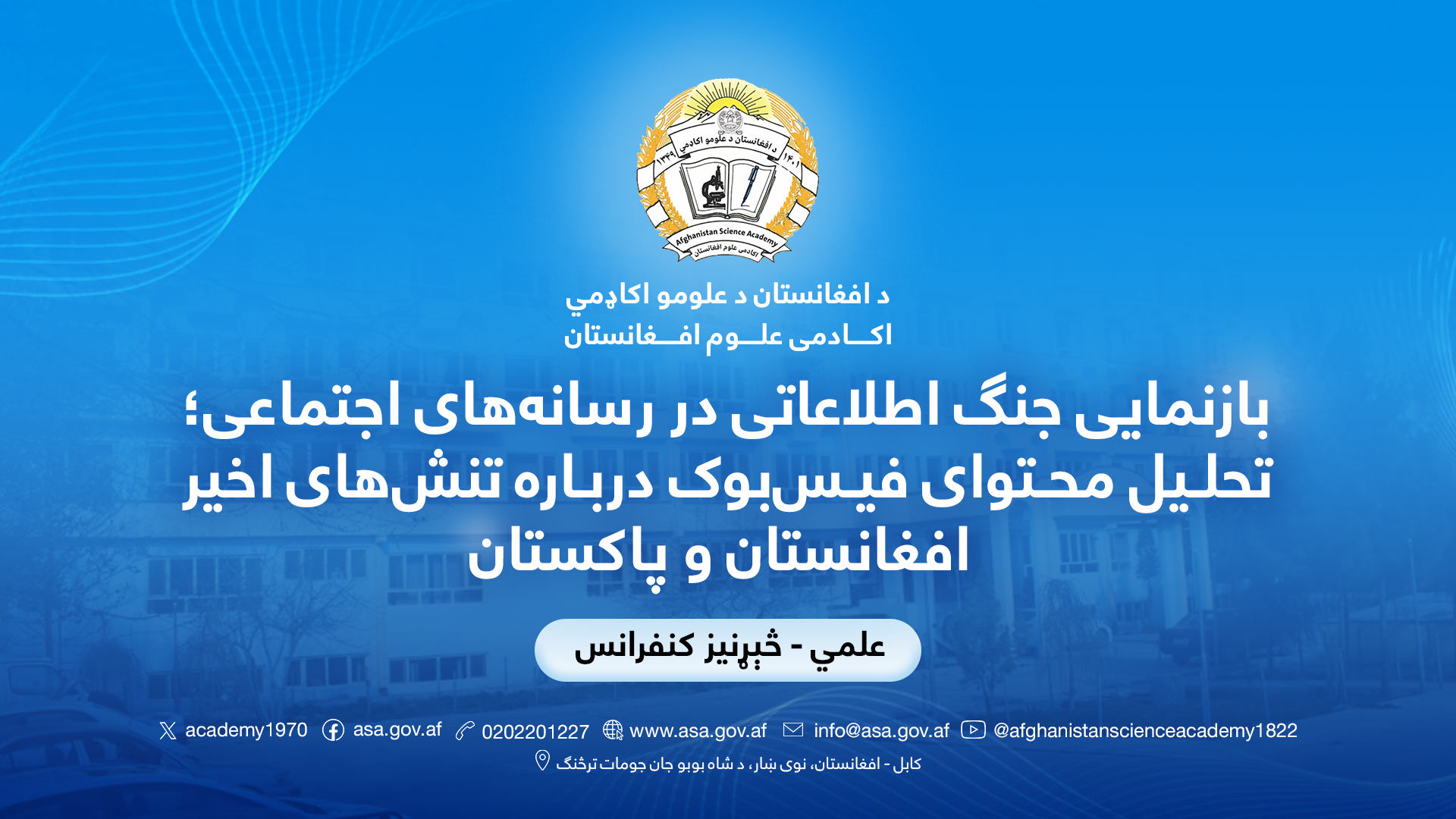
The scientific-research conference entitled “Representation of Information Warfare on Social Media; A Content Analysis of Facebook Regarding the Recent Afghanistan–Pakistan Tensions” was held on 19/2/1405 at the Center for Social Sciences. During this academic session, researcher Hekmatullah Aziz, as the presenter, analytically and scientifically examined the issue of information warfare and the role of social media.
At the beginning, an introduction was presented regarding the transformation of warfare in the digital age. It was explained that social media platforms, especially Facebook, are no longer merely tools for information transmission; rather, they have become arenas of narrative competition, perception management, and information warfare. Using the theories of information warfare, propaganda, echo chamber, and representation theory, the presenter explained the theoretical framework of the research and emphasized the importance of analyzing social media in understanding contemporary conflicts.
Subsequently, the statement of the problem and the objectives of the research were discussed. In this section, it was explained that the main objective of the study was to investigate how information warfare is represented in Facebook content related to the recent Afghanistan–Pakistan tensions. The social, security, and media-related significance of the study was also highlighted, with particular emphasis on the necessity of combating misinformation, polarization, and enemy-making narratives.
The methodology section included an explanation of the research method, statistical population, and data analysis procedures. The presenter stated that the study was conducted through quantitative and interpretive content analysis of 107 Facebook posts, and that SPSS software along with various statistical tests was used for data analysis.
In the findings section, the results showed that the majority of the content consisted of text accompanied by images, and that visual elements played a significant role in attracting user engagement. Furthermore, security-oriented and enemy-making frames were found to dominate over peace-oriented frames, while a large portion of the content reflected biased orientations. The findings also indicated that Pakistan was represented as an “enemy” in many posts, and that signs of nationalism, emotional appeal, and polarization were evident in a considerable amount of the content.
The presenter further discussed the statistical analyses, which demonstrated significant relationships between nationalism, enemy-making, content orientation, and the representation of Pakistan. In addition, the analysis of user engagement revealed that posts containing stronger emotional and visual elements received higher levels of interaction.
In conclusion, the presenter stated that Facebook is not merely a reflection of political tensions, but has itself become part of the field of information warfare. Recommendations were also provided regarding the promotion of media literacy, combating misinformation, reducing enemy-making narratives, and producing balanced content. The question-and-answer session was warmly welcomed by the participants, who expressed satisfaction with the scientific quality, coherent structure, and presentation style of the conference.
